Monday, August 26, 2013

Orange Juice - You Can't Hide Your Love Forever


You Can't Hide Your Love Forever (1982) ***1/2

Rock'n'Pop has always fetishized adolescence, yet the lads in the Orange Juice find a novel angle of approach:  few albums have captured the gangly, awkward essence of growing up too fast so well, as your sprouting body seems to clumsily trip over itself, while your inexperience with social interactions and conventions causes you to trip over yourself even more embarrassingly.  The key adjective here is 'awkward'.  These are supposed to be catchy jangle-pop tunes, but the band can't (or won't) perform them in a straightforward manner.  The arrangements seem jarringly cluttered for such clean and spare music.  Sometimes the clattering drums or bobbling bass seem mixed too loudly, distractingly so, with the tinny hooks buried behind the fussy busyness.  More often is the case, the band have mis-mastered the art of the awkward transition, as once they settle into an acceptable groove for a few seconds they immediately and jarringly abandon it - going from smoothly crooned pop in the verses to hyperkinetically charged white-boy funk for the chorus, for one example, or trying to shoehorn a bouncy waltz and a militaristic four-four march into the same tune (at the same time).  On first listen, I couldn't take it all in; this was supposed to be pop music, not Captain Beefheart - you're not supposed to have to work at it.  Yet the band had at least some minor historical importance, being a key member of the wave of neo-pop post-punk bands that laid the foundations for the sound of Young Scotland on Postcard Records in the early '80s (the other two being Josef K and Aztec Camera - see those reviews).  So I resigned myself to a second listen, and it started to make a little more sense as I started to notice the details.  And finally after many repeat listenings, I got it.  What initially seemed like deliberately obtuse arrangement gaffes transmuted into quirks essential to the band's charm.  Frankly, I was wrong:  if this had been a catchy pop album that hooked me immediately, that's all it would ever amount to.  It is a catchy pop album, but one that's unusually eccentric and therefore more compelling. 

To put it "In a Nutshell," as Edwyn Collins croons (yes, that '90s one-hit wonder), Orange Juice's jittery post-rockabilly sound provides the missing link between the Talking Heads and the Smiths.  (Not to mention Vampire Weekend - yes, that's right, please don't mention them.)  James Kirk (no, not that James T. Kirk) plucks and strums away on the high end notes of the guitar scale, for a clean, spare hook foundation that self-consciously avoids macho rock cliches.  In fact, this album is downright fey, with the band wearing their collegiate nerdiness and wimpiness on the sleeves of their Cardigan sweaters.  O, Edwyn - even more initially offputting for the unprepared listener than the cluttery arrangements is his voice.  Collins' mannered vocals come across as a Bryan Ferry imitation on quaaludes, and a callow youngster's imitation at that - he's many years away from the deep soul crooner he would become on "A Girl Like You".  He takes some getting used to, is what I'm saying, and I still haven't entirely made my peace with the vocals on this album.  Kirk (the other main songwriter and creative force) takes a few lead vocal spotlights, and his more conventional but bland and characterless vocal style highlights the advantage of having a highly distinctive vocalist (love him or loathe him) in your band.  In addition, Collins is the sort of proto-Morrissey who deliberately slips in a word like "discourteously" into a verse no matter how awkward it scans.  (There's that adjective again.)

While the obvious influences of the Velvet Underground, Television, and the Talking Heads aren't surprising in an early '80s post-punk band, there's another crucial influence that sets Orange Juice apart from their Scottish peers:  classic soul.  This evidences itself not only in the Al Green cover ("L.O.V.E. Love"), and not just the slippings into light funk at times (on others they do a credible Velvets snapping-bicycle-chains jangle), but mostly in the sheer upbeat joyousness of this music.  "Upwards and Onwards," isn't sung with a trace of smirking irony, and it's not hard to see which part of the "Falling and Laughing," ultimately wins out.  It's also a bright and clean-cut sounding record - an innocent, romanticized '50s feel musically derived from '60s sources updated for the '80s.  In other words, the Smiths.  But a happy Smiths!  A 3.75 star rating, but I'm not rounding up, after realizing that while highly pleasant and enjoyable as a whole, there just aren't any true knockout tracks present.  It's special but not that special; just, in the end sum of things, another catchy jangle-pop album - albeit one that takes some time getting used to.

One more detail:  in "Untitled Melody," Collins talks about buying some sun-specs from a local hipsters' store.  See, kids?  For those whose memories extend beyond last week, they didn't spring out of nowhere in the past decade.  Hipsters were alive and rampant in 1982.  And in 1952, if you've ever heard of these fellas who called themselves the Beats....


Sunday, August 25, 2013

Steve Harley - Hobo With a Grin


Hobo With a Grin (1978) ***1/2

Well, Steve's finally put the left & right sides of his brain together and delivered his best album since The Best Years of Our Lives.  While it's primarily a heartfelt singer-songwriter album, Harley doesn't entirely ignore the musical side of things, nor does he flake out with too much poorly conceived experimentation.  Oh, and it's his first "official" solo album, but we all know that hasn't mattered since the first pair of Cockney Rebel LPs.  Anyhow, this is perhaps Harley's most soulful album to date.  Previously, Harley's lyrical motivations were shrouded in an enigma encased in a mystery, but the lyrics here aren't terribly difficult to figure out most of the time.  One aspect of Harley's persona to be noted is that the man apparently is a sincere Anglican and judging by some of his politically-oriented lyrics here and elsewhere ("Red is a Mean, Mean Colour," remember that one?), he's of at least a mildly conservative temperament.  Thus we get the worst track, the misguided funk excursion, "(I Don't Believe God) Is An Anarchist," which could be a specific rant about punk or a more generalized rant against nihilistic youth culture in general.  He's sick of revolutions that never improve the general lot anyway, but it's not the lyrics that let me down (the message is fine - Harley's just a conservative in the Edmund Burkean sense, which is to say the most respectable kind), it's the gratingly hamfisted funk.  When will Steve get it drilled into his dancing feet that the whitest of white Englishmen have no business shaking down like he's Sly Stone?  That track aside, the rest of the album will neither impress nor offend you, musically speaking, though it may bore you if you're not so inclined:  it's just standard-issue soft-rock, sometimes lively and rollicking (the lead single "Roll the Dice"), sometimes narcotically soothing ("Riding the Waves (For Virginia Woolf").  The message of the most overtly political tract, "Hot Youth," may seem a recitation of headline doggerel at first, but it's not too hard to figure out with a bit of concentration.  Harley's simply observing that politically disaffected youths will always be angry no matter what the specific political situation; if there wasn't a wall in Berlin, there'd be another wall to climb over.  The peppy "Amerika the Brave," employs Columbus as a metaphor for how the U.S. is a magnetic dragnet for modern day Europeans like himself.  And once you realize that the 'someone' in "Someone's Coming," is the return of Jesus, it all falls into place lyrically.  As if a title like "Faith, Hope and Charity," didn't make it clear where Harley's heart was around this time, spiritually speaking.  Which must have been a good place, if it produced such warm and soulful ballads as "Living in a Rhapsody," a tune that oozes the essence of Steve at his most tender, emotionally sincere, and moving.

The selection for bonus tracks are quite bafflingly random, as both of the two were nowhere near 1978.  "Spaced Out," was an early Cockney Rebel B-side; it's fine but nothing special fiddle-pop and is quite jarringly placed here.  "That's My Life in Your Hands," is a live recording of a number that would resurface nearly two decades later (in a studio version) on a '90s Harley comeback album.  It's breathlessly rushed folk-pop, but it doesn't come from this era, either - apparently recorded sometime in the '80s when Harley was on his decade-long recording-studio retirement.


Friday, August 23, 2013

Brinsley Schwarz - Hen's Teeth


Hen's Teeth (1998) ***1/2

Those interested in the early heydays of Brinsley Schwarz are advised to skip over the first pair of albums and go directly here, for reasons of both chronology and quality.  This grab-bag of tracks (most of which were not released under the Brinsley Schwarz name) spans from 1967 to 1975, broken down thusly:

1-10:  Kippington Lodge, the mod-era precursor to the Brinsleys
11-12:  The Hitters, the Brinsleys in dreadlocks as a one-off cover of Leroy Sibbles' "Hypocrite," which was credible.  The flip side, an instrumental dub version entitled "The Version," however was not.
13-16:  The contents of a pair of A/B-sides released under the Brinsley Schwarz name, but not placed on any albums, since the A-sides were covers that ventured too far afield from the Schwarz's laid-back country-pop.  A shame that the Brinsleys had hitched themselves to such a stylistic album-oriented rut, as both Naomi Neville's R&B roller "I've Cried My Last Tear," and Tommy Roe's bubblegum-glam stomp "Everybody," are fine tunes that prove the Brinsleys were adept at more than just hippie neo-twang.
17-20:  A/B-sides by the Knees and the Limelights, aliases for four Vanilla Fudged Beatles covers.  While it's practically impossible to improve upon the originals for even the brightest of talents, these are all good fun, and these Beatles chestnuts are amusing to hear to in a modernized (for 1975) context.
21-22:  The final Brinsley Schwarz single, released in the year after their final LP.  Both the A and B are fine little pop/soul confections.  Nothing earth-shaking, just well-crafted pop, which sums up the Brinsleys for ya.

The Kippington Lodge material deserves a paragraph of its own.  By the time the Lodge had changed their name to the Schwarz, of the original members only the guitarist Brinsley Schwarz remained - mystery of eccentric nomenclature solved.  Little of this material was composed by the band themselves, much to their chagrin, with songs shoved at them from outside 'professional' songwriters - but like a famous man once said, "Those were different times."  For factory pop, most of it's pretty dandy, and if their only artistic contribution to their debut single "Shy Boy," was the vocal track (session musicians sat in on the commissioned tune), that doesn't change the fact that "Shy Boy," is wonderful little slice of Brit-pop - it could've fit in fine on Something Else by the Kinks or even more appropriately The Who Sell Out.  Reminds me a bit of "Odorno," for some reason.  Must be the office setting.  The flip side, "Lady on a Bicycle," is even more intriguingly odd (for the times) lyrically - a gushing schoolboy ode to an older dame who'd most likely find herself on the Sex Offender registry these days.  She gives this teenage boy a ride on her bicycle every day to school, you see, goes the storyline....  While none of these early tunes sound like surefire hits, they're all good songs, comfortably entertaining on the B to B+ level of songcraft.  It's surprising that none of these wound up on the U.K. version of Nuggets box set - picking one or two for inclusion would've fit that collection just dandy.  The final Kippington Lodge single is of note for two reasons:  the A-side is the first of their several bombastically metallized Beatles covers ("In My Life"), while the B-side is notable for being the first Nick Lowe composition to make it to record (the urgently paranoid "I Can See Her Face").  Minor-league but entertaining (as usual), these odds'n'ends snapshots may be the best place to get first aquainted with the Brinsleys.

Not much of this material available on Youtube, unsurprisingly.  This underproduced, inferior BBC radio session version of "Shy Boy" will just have to do.


Neu! - s/t


Neu! (1972) ***

An enormously influential, beyond ahead of its time album that is half unlistenable, and I mean that in the literal sense:  Neu!'s debut schizophrenically splits its six tracks between the OMIGOSH IMA GOBSMACKED and the WHAT THE HELL IS THIS CRAP?!  Let me break it down for you:


No. Title Length
1. "Hallogallo" (Play on "Halligalli", a German slang term for "wild partying", with the word "hallo" being German for "hello") - MAYBE I'M AMAZED, NO NO MAYBE, YES I AM! 10:07
2. "Sonderangebot" ("Special Offer") - POINTLESS FILLER BETWEEN THE MAIN COURSES 4:51
3. "Weissensee" ("White Sea" or "White Lake"; Weißensee is a town in Carinthia, Austria, and a borough of Pankow, Berlin) - SLOW AS SNAILS, STILL GROOVY-TASTIC, MAN! 6:46
Side two - Jahresübersicht
No. Title Length
4. "Jahresübersicht (Part One): Im Glück" ("Lucky") - WHAT THE HELL IS THIS SHIT 6:53
5. "Jahresübersicht (Part Two): Negativland" ("Negative Land") - HOLY MOTHER OF #@!$%!, THIS IS WHAT I CALL NEO-AMBIENT GUITAR SQUALL! 9:47
6. "Jahresübersicht (Part Three): Lieber Honig" ("Dear Honey" or "Preferably Honey") WHAT THE HELL IS THIS SHIT?  SERIOUSLY, DUDES.  YO MAN THIS SHIT BE WHACK YO, THAT'S LIKE THE GAYEST RETARDED VOCAL I'VE EVER HEARD IN MY LIFE.      7:18


Danke, Wikipedia.  Michael Rother (credited to guitar & bass) and Klaus Dinger (credited to guitar, drums, and something called "Japanese banjo", if such a thing even exists and was not an in-joke in the credits) split from an early version of Kraftwerk, reasoning given that the Krafts were insufficiently experimental.  And while being the first full-fledged synth-pop, guitar-less outfit made the Werks the most influential German band of the decade (do I need that 'German' modifier?), Neu! might've been equally hallowed if not for their brief, aborted three-album career.  According to lore, their debut was recorded in a scant four days in 1971, the first two proving fruitless - which goes a long way to explaining why they only came up with 3 good songs.   To squeeze its influence in as tight a nutshell as possible, this sounds like a vocal-less 154 era Wire or late '70s Joy Division (in retrospect, both extremely obviously influenced).  Neu!'s basic formula. introduced on the opening track, is to lay a bedrock of hypnotic rhythmic repetition, with its unvarying 'motorik' drumbeat and two-note bass riffs providing the musical center.  Overlaid are treated guitars that at times sound like synthesizers, floating in and out and around the mix, to keep the music varied enough so that you're hypnotized by the beat instead of bored by it for ten minutes.  The spare, minimalist textures of this completely instrumental work keep the album completely contemporary, no matter what decade it happens to be - tell some hipster that this is one of the latest post-rock albums on the critics' year-end list of 2012, and he'll fall over pretending that it's cutting edge; and in 2022 or 2042 as well, I'm wagering.  Context counts for quite a lot in pop music, however, and what could this music have been categorized as in 1972?  Post-psychedelic and mind-bending - not a partaker of hallucinogens, so I can only imagine just how good this has to sound on drugs, and I do not mean that as an insult.  Perhaps I'll experiment someday with a reefer.  (Listening to this album, I mean.  Like 92.635% of Americans, I've partaken of that.)  Yet its mechanical beats, squalling guitar noises, and the icy, impersonal to the point of inhuman feel point the way to industrial.  But it's hardly a hard-rocking album, for the most part - Neu! know the value of space in music, leaving large sonic potholes that give a number of tracks a peaceful, dreamy effect.  So there's proto-ambient and post-rock in the mix as well.  And while, according to the credits (your ears deceive you), there's not a synthesizer present, it certainly sounds like a pioneering synth-rock album, and its emphasis on tight, driving, ferociously monotonous-minded rhythm - well, free your ass and your mind will follow, that's late '70s disco, tisn't it?

To recap:  this would've been a classic for the three mind-blowing tracks.  But no matter how mind-expanding and influential those may be, the other half of the album is painfully obvious found-sound and dicking around the studio filler.


Thursday, August 22, 2013

Flamin' Groovies - Jumpin' in the Night


Jumpin' in the Night (1979) ***

More of the same, with a grand total of six originals and seven covers this time.  The tunes flowing from the pen of Jordan/Wilson are still fine, if no all-time great knockouts.  It starts off strongly with the jittery title track, which segues into the bruisingly Lennon-ish "Next One Crying."  The homesick "First Plane Home," and the joyously patriotic "In the U.S.A." flow well into each other thematically - got those London homesick blues, eh boys?  "Yes I Am," and "Tell Me Again," are again fine British Invasion originals, but there's not a lot of territory the Groovies have not well-mined on the previous two LPs.  The covers are particularly weak this time out.  Three Byrds covers are two too many, and while the band seems to have based their entire late '70s career on rewriting "Please Please Me," it's not one of their best stabs at the Fabs.  And "Absolutely Sweet Marie"?  What business do the Groovies have of covering Dylan?  Totally out of their comfort zone.  Speaking of which, most bizarre of all is Warren Zevon's "Werewolves of London".  Idiosyncratic novelty tunes often verge on the uncoverable, and Zevon's fluke hit of the previous year was no exception - especially minus the swinging ragtime piano that was the musical bedrock of the original.  Rather pointless if you ask me, but so have the Groovies been since 1976.  Ouch - that was a mite too harsh.  Look, these are pretty groovy little rock'n'roll albums if you're looking for nothing other than a lightweight mix of oldies and like-minded originals.  I enjoy'em.  But that doesn't mean I have to take them seriously.

Completing this third and weakest installment of the late '70s trilogy, the Groovies wisely called it a day.  Well, for the most part - rockers still gotta earn their bread with reunion shows, and who's gonna begrudge'em?


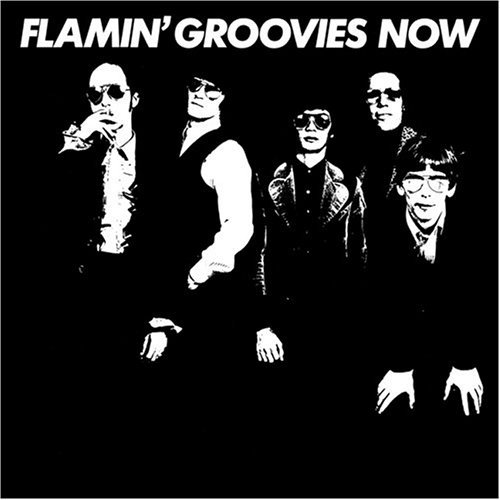
Flamin' Groovies - Now


Now (1978) ***

The previous album had kicked off with the immortal "Shake Some Action," and this followup begins with a cover of "I'll Feel a Whole Lot Better," which should underscore all you need to know concerning the differences between the two LPs.  I should end my review right here, because this is not a terribly interesting album about which there is a lot to say.  Essentially it is a carbon copy of the 1976 LP, the main difference being that while that album was bogged down slightly by a handful too many covers, this album is overwhelmed by the amount of sweatin' oldies.  Of the 14 tracks, only six are Jordan/Wilson compositions, one of which is the fine, deliberately mindless Dave Edmunds co-write "Yeah My Baby," which choogles along like a glue-huffing CCR.  The other Edmunds/Jordan/Wilson co-write, "Good Laugh Man," is similarly fine if insubstantial pop.  There's nothing here as life-changing as "Shake Some Action," though the snarling kiss-off "Don't Put Me On," comes close, with a venomous vocal and deranged fuzz-rockabilly solo - classic Groovies.  But oh, those covers.  Byrds, fine.  Beatles, finer - in fact "There's a Place," is definitive, gushing with energy (the original was cut near the end of a day-long session and the Fabs delivered a draggy, hoarse take that lacks all drive).  Paul Revere & the Raiders - um, OK.  "House of Blue Lights" and "Move It" - yeah, yeah, go on do your boogie raveup thing.  King Curtis - now that's what I call R&R, baby.  And while picking an undervalued Stones obscurity ("Blue Turns To Grey") was a choice idea, a sitar-less take on "Paint It Black" was not.  It's all harmless fun (moreso for the band than the listener, I suspect) and the Groovies do put their unique stamp on all the covers - how could they not with those patented six-strings?  But it's basically an up and coming bar band's set list - interspersing a handful of originals with the crowd-pleasing oldies - and that is simply not acceptable from a band capable of much more.


Wednesday, August 21, 2013

Flamin' Groovies - Shake Some Action


Shake Some Action (1976) ****

Just in time for punk, the Groovies minus Roy Loney had successfully retooled their sound and image as British Invasion revivalists, as one can tell from the sharp Mod suits on the cover.  Dirty hippie long-hair begone, it's bowl-cuts from now on.  The first installment of their late '70s Power-Pop Trilogy is easily the best; this and the two follow-ups are practically the same three albums in terms of style and approach.  The only substantial differences are the strength of the original material and how heavily the band relies on covers.  While the next two albums went overboard with reliance on oldies, only 5 of these 14 songs are covers.  Chuck Berry, the Beatles, Lovin' Spoonful, W.C. Handy - they're slight but fun, the definition of harmless filler.  Which is a pity since nearly every single original present in the Bicentennial Groovies' lineup either rocks, rules, or tears out your heartstrings, sometimes all three.  I went on about the title track and "You Tore Me Down," in my review of the previous Groovies' release, so no more here when I could be discussing "Yes It's True," a note-perfect recreation of a lost Help! era album track.  Or "I'll Cry Alone," which does the same for depressively moody Gene Clark era Byrds - perfect for moping around the dark streets alone, yet it's a driving "Paint It Black," style surger.  "I Saw Her," throws in some incense & peppermints psychedelia, while "Teenage Confidential," essays early '60s teen breakup balladry.   "Please Please Girl," and "I Can't Hide," come from the same place musically, both hyperkinetic jangle-pop that jumps out of its skinny jeans.  And have I mentioned that Cyril Jordan, now defacto leader of the Groovies, has polished to a T the perfect guitar tone for this sort of music?  It's light, not in the least bit heavy or distorted - clean and crisp, jingle-jangling like a harder rocking Byrds.  Not since Big Star have guitars sounded so shimmery, shiny, and colorful, with not a hint of stereotypical muscle-car '70s blooze macho, but still rockin'.  If not for the covers, I'd be tempted to rate this higher, slavish revivalism and all - these aren't just pale copycats of British Invasion classics, they stand up to the best of the Dave Clark Five and Hollies in their own right.

Oh, and have I mentioned the title track?  BLOODY FREAKIN' GENIUS.